Connect
Sign up to receive our monthly newsletter.
Inquiries
Have a question? Contact us here.
Job Opportunities
Learn about job openings.

Digital Public Goods Alliance - 2026
Sign up to receive our monthly newsletter.
Have a question? Contact us here.
Learn about job openings.
C4CA2 – Comprehensive resources and tools for building responsible AI systems
Below are some complementary toolkits developed by various organisations, including educational materials, resources, templates, and checklists, which all aid different stakeholders in the production of open data sets.
Designed to help governments, Bank staff and users understand the basic precepts of Open Data, then get "up to speed" in planning and implementing an open government data program while avoiding common pitfalls.
Designed to provide practical tools to facilitate and enhance the implementation of data-driven initiatives for the public good by public servants.
This Blueprint provides guidance and resources to support organisations (particularly those that have or steward data) seeking to create data commons for AI in the public interest.
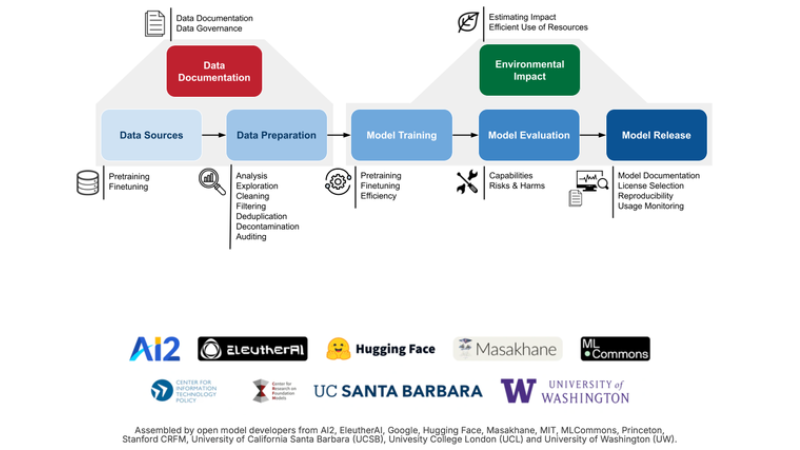
The research outlines possible tiers of openness, normative principles, and technical best practices for sourcing, processing, governing, and releasing open datasets for LLM training, as well as opportunities for policy and technical investments to help the emerging community overcome its challenges.
Designed to support Lacuna Fund grantees and the broader machine learning community in publishing sustainable AI training datasets. The toolkit is intended as a step-by-step playbook, with guidance and checklists that researchers can reference as they prepare their datasets to ensure widespread reuse by others, covering topics like guidance on producing high-quality datasets before publication, selection of appropriate platforms to host the dataset, etc.
Designed to identify and catalog critical data gaps that impede AI/ML applications in addressing climate change, and lay out pathways for filling these gaps (candidate improvements to existing datasets, as well as "wishes" for new datasets whose creation would enable specific ML-for-climate use cases).
Designed to offer practical, region-specific guidance for countries working to strengthen their AI ecosystems due to difficulties in policy development, governance, unequal access to compute resources, etc.