Connect
Sign up to receive our monthly newsletter.
Inquiries
Have a question? Contact us here.
Job Opportunities
Learn about job openings.

Digital Public Goods Alliance - 2026
Sign up to receive our monthly newsletter.
Have a question? Contact us here.
Learn about job openings.
December 1, 2025
Reflections from the 2025 Annual Members Meeting in Brasília
Last week, the Digital Public Goods Alliance (DPGA) concluded its fourth Annual Members Meeting (AMM)— its first ever in South America—with three energising days of collaboration, shared learning, and collective momentum. Taking place in Brasília and held in partnership with the Government of Brazil, represented by the Controladoria-Geral da União (CGU), the Ministério da Gestão e da Inovação em Serviços Públicos, and DATAPREV, this year’s AMM served as a capstone to 2025’s steady global progress and growing interest in digital public goods.Over the course of this year’s Annual Members Meeting, more than a hundred representatives from DPGA member organisations - including country governments, in addition to digital public good (DPG) product owners, explored how DPGs can help countries and development partners, including multilateral development banks and UN-agencies, navigate geopolitical and technological shifts while delivering real benefits for people’s lives and for the planet. It also served as an opportunity to welcome Co-Develop, co-coordinator of the 50-in-5 campaign, as the newest member of the DPGA.This year’s AMM reflected how far the DPGA has come, and the role it is increasingly poised to play amid rapid advances in technology and significant geopolitical change.The gathering opened with reflections on key achievements from the past year, including:Growth and maturity across the DPG ecosystem, seen through continued expansion of the DPG Registry—now with well over 200 verified digital public goods—and increased collaboration among DPGs themselves, demonstrating how open, interoperable digital solutions can drive scale and impact.Strengthened global alignment, with DPGs front and centre at major convenings including COP30, UN Open Source Week, the Internet Governance Forum in Norway, and the annual 50-in-5 Milestone Event on the sidelines of the UN General Assembly. Continued advances in understanding how DPGs can be used for DPI implementation, including the launch of the DPG4DPI Collection, which is already helping countries more easily identify DPGs that enable safe, inclusive, and interoperable DPI.Significant progress on climate, marked by a new framework to identify DPGs for climate action and Brazil’s announcement of a newly shared open-source module derived from its Rural Environmental Registry (RER).Strengthening efforts to sustain DPGs, with growing alignment on the need for upstream maintenance, flexible financing, and stronger contribution pathways to ensure that governments and partners can adopt, adapt, and maintain DPGs over time.Together, these achievements created a strong foundation for workshops and roundtable discussions that unfolded in Brasília.“We believe that open technologies and global digital governance contribute to better governments, but also to stronger democracies and enhanced sovereignty. These joint activities and collective sharing really embody that spirit. Let us all work together in that direction to promote inclusive and sustainable development, powered by open technology strategies.” - Cristina Kiomi Mori - Vice Minister of Management and Innovation in Public Services, Government of Brazil
November 21, 2025
Four Policies That Can Unlock the Promise of Digital Public Goods
Digital public goods (DPGs) are open-source technologies that countries can freely adopt to accelerate digital transformation, improve residents’ lives, and drive economic growth. For governments and large organisations, DPGs hold the promise of increasing efficiency and technology transparency while preserving their digital sovereignty, and avoiding costly lock-ins.However, in order to better facilitate the potential of DPGs to deliver on these benefits, governments and organisations should prioritise implementing policies, principles and frameworks. Doing so could allow them to more effectively implement DPGs that address country needs which may include evolving their digital public infrastructure.For this reason, the DPGA Secretariat included dedicated emphasis on this as part of the Calls for Collaborative Action that were launched in November 2024.
June 12, 2025
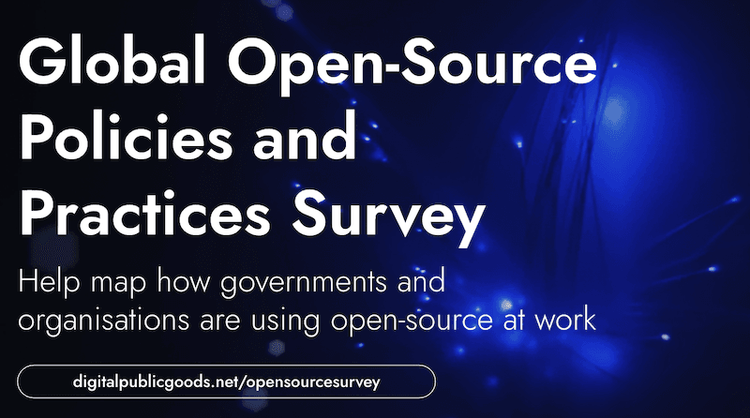
Launching the Global Open-Source Policies & Practices Survey
Today the DPGA Secretariat, in coordination with twenty-four organisations, is launching the Global Open Source Policies & Practices Survey. Directed at governments and organizations, this survey aims to significantly improve understanding of the current landscape of open-source policies, principles, and frameworks among governments and organizations.

July 20, 2020
Announcing the First Vetted Digital Public Goods for Foundational Literacy and Early Grade Reading
We are excited to announce the first set of vetted digital public goods, a list of openly licensed platforms, content, and technologies focused on Early Grade Reading that have been reviewed by a grou...